

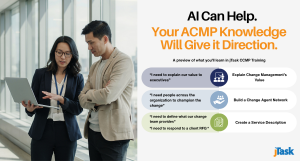
This isn’t a list of prompts to copy and paste. It’s three worked examples of the actual skill: matching a real business situation to the exact section of the ACMP Standard that applies, then using AI to turn that mapping into a finished deliverable. In jTask CCMP Training, you learn to build this mapping yourself — for situations well beyond the three below.
-
Explain change management’s value — ACMP 4.1 (Change is a Process)
The ACMP Standard defines change management precisely: “The practice of applying a structured approach to the transition of an organization from a current state to a future state to achieve expected benefits” (ACMP 3.5). Every new sponsor or skeptical stakeholder is a chance to make that case, not a problem to overcome — and the same argument works whether you’re an internal practitioner convincing your own leadership, or a consultancy pitching a prospective client on why the engagement needs change management, not just project delivery. The Standard’s 4.1 argument: benefits only occur when a change is adopted — never when it is merely implemented. Seat belt laws are a clean illustration: the law is implemented the day it passes, but road traffic fatalities don’t drop until people actually adopt the behavior of buckling up. The law alone produces zero benefit.
Make it real before you present it: when you actually show this to a customer or your own leadership, don’t leave “current state” and “future state” as generic labels — replace them with the specific transition this audience is facing (e.g., “manual approvals → automated workflow”), and name real, concrete benefits (e.g., “3-day approval cycle → same-day”), not abstract ones. A generic curve is a diagram; a curve labeled with their own transition and their own numbers is an argument.
The mapping: an opportunity to explain change management’s value — externally as a sales pitch to a prospective client, or internally to your own leadership → the Standard’s own definition (3.5) and Implemented-vs-Adopted argument (4.1) → a presentation built around that distinction, made concrete with the audience’s actual transition and benefits.
Work with AI like this to get that outcome: “Build a sales/executive presentation using the ACMP Standard’s definition of change management (3.5) and Concept 4.1 (Change is a Process). Make the central argument that benefits only occur when a change is adopted, not when it is merely implemented — use a concrete illustration (e.g., a law that is passed but not yet followed produces zero benefit until adopted), distinguishing Change Implemented from Change Adopted. Replace the generic ‘current state’ and ‘future state’ with [describe the actual transition] and include [specific expected benefits] to make the argument concrete rather than abstract. If pitching as a consultancy, frame this as the reason the engagement should include change management, not just project delivery.”
-
Build a Change Agent Network — ACMP 4.6 (Roles and Responsibilities)
Rather than relying on top-down messaging alone, the Standard gives you a specific mechanism: Change Agents — functional or social leaders and subject matter experts, trusted by colleagues, chosen for their influence and network, who model the target behavior and feed back on how the change is landing.
The mapping: adoption stalling mid-project → the Standard’s own definition of Change Agent roles (4.6) → a nomination request, an evaluation checklist, and a kickoff invite built on that definition, not a generic “pick some champions” list.
Work with AI like this to get that outcome: “Using ACMP Standard 4.6 Change Management Roles and Responsibilities, build a Change Agent Network: a manager nomination request, a Change Agent evaluation checklist (influence, trust, network, role-modeling), and a kickoff invite.”
-
Turn the 5-phase process into a service description and SOW pricing model — ACMP Section 5.0 (Change Management Process Groups)
Before the Standard even gets to 5.1, it establishes that the five process groups — Evaluate, Formulate Strategy, Develop Plan, Execute Plan, Close Effort — are linked: “the output or result of one process becomes the input of another process.” That linkage is exactly how you should structure a SOW in response to a request for proposal, or a service catalog to market your internal services. Evaluate (5.1) and Formulate Strategy (5.2) naturally form Phase 1 — you assess the change and bring the customer a set of strategic choices to agree on. Develop Plan, Execute, and Close (5.3–5.5) form Phase 2 — priced and scoped only once those choices are agreed. If you deliver internally rather than to a client, this same structure is your team’s actual operating process. Either way, the outputs of each process group become the line-item deliverables in your SOW or service catalog — not generic milestones.
The mapping: pricing a proposal, or defining an internal service catalog → the Standard’s own process-group linkage (Section 5.0) → a two-phase pricing and deliverable structure built on that linkage.
Work with AI like this to get that outcome: “Using ACMP Standard Section 5 (5.1 Evaluate, 5.2 Formulate Strategy, 5.3 Develop Plan, 5.4 Execute Plan, 5.5 Close Effort), build a two-phase service description and SOW pricing structure. Phase 1 = Evaluate + Formulate Strategy, ending in a customer/sponsor decision gate on strategic choices. Phase 2 = Develop Plan + Execute + Close, scoped and priced only after Phase 1 choices are agreed. For each phase, list the specific process outputs from the Standard as line-item deliverables.”
The point
None of these three examples are meant to be copied into your own work as-is. They’re demonstrations of a skill: recognizing which section of the ACMP Standard a real situation calls for, then using AI to apply it correctly and quickly. That’s the skill jTask CCMP Training teaches — not a longer list of prompts.
If you are ready to elevate your change management and AI skills, secure your spot today.
For Additional Information
Please contact info@jtask.com
Legal
jTask CCMP Training and jTask CCMP MemoryPak are trademarks of jTask, Inc. ACMP and CCMP are registered trademarks or trademarks of the Association of Change Management Professionals.